
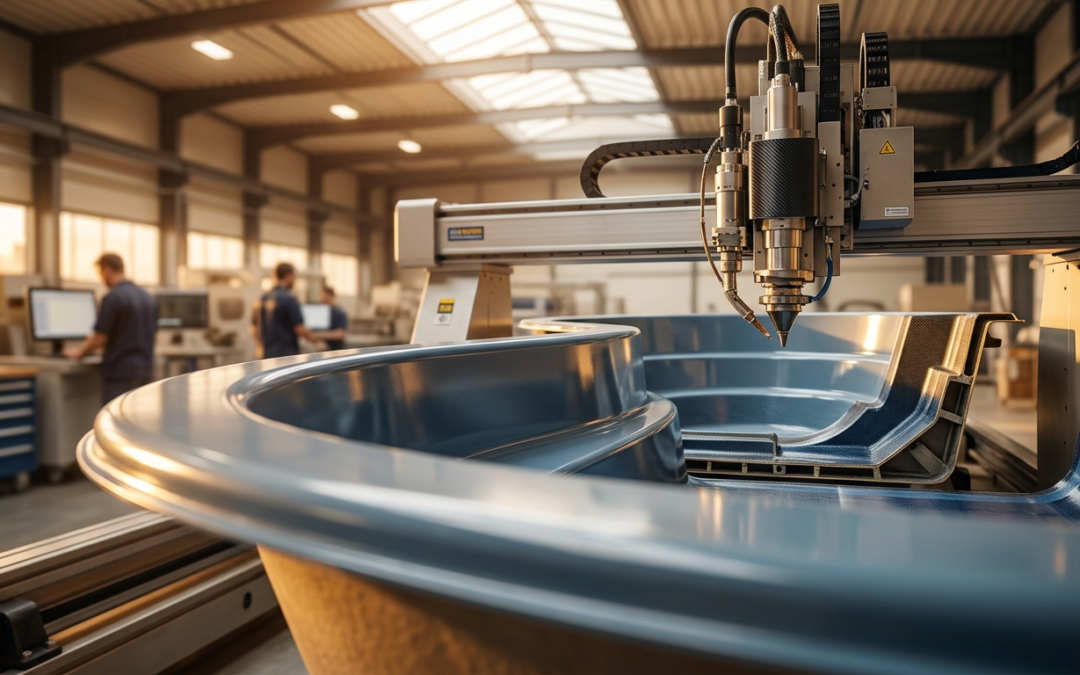
When you invest in a premium composite swimming pool, you are not just buying a product. You are buying confidence in a manufacturing process that will hold up for the lifetime of your home. That confidence starts on the factory floor, long before the shell is ever craned into your garden.
Automated production methods are central to how the best composite pools are built today, and understanding what that means in practice can help you make a more informed buying decision.
Why Consistency Is Everything in Pool Manufacturing
A composite pool shell is a structurally complex component. It needs to be dimensionally stable, chemically resistant, and strong enough to hold tens of thousands of litres of water for decades without flexing, cracking, or delaminating. Achieving that reliably, batch after batch, is genuinely difficult.
Traditional hand-laid manufacturing introduces variability at almost every stage. The thickness of each layer, the resin-to-glass ratio, the curing time, the surface finish quality: all of these can shift depending on the operative, the ambient temperature, and even fatigue at the end of a shift. Automation removes those variables from the equation.
When a mold is prepared and laid up using controlled, programmed systems, every shell produced to that specification receives the same treatment. Layer thickness is applied uniformly. Resin distribution is consistent. The process does not have a bad day.
What Automated Composite Molding Actually Involves
For composite pool shells, automation typically operates across several distinct stages of production.
- Gelcoat application: The outer surface layer is sprayed using automated equipment calibrated to a precise thickness. This gelcoat is the surface you see and touch in your finished pool, so uniformity here directly affects aesthetics and long-term colour stability.
- Composite lamination: Successive layers of fibreglass and resin are applied in controlled conditions, with each layer given the correct cure time before the next is added. Automated systems maintain the ratios and timing that hand application can struggle to replicate at scale.
- Structural reinforcement: High-load areas such as steps, benches, and swim-out platforms receive additional structural attention. Automation ensures these reinforcements are placed consistently, not approximately.
- Dimensional checking: Finished shells pass through quality control processes that verify critical dimensions before they leave the factory. Any shell that falls outside tolerance is caught at this stage rather than discovered on your installation day.
The result is a shell that matches its specification precisely, every time it is produced.
The Link Between Automation and a Genuine Lifetime Warranty
Manufacturers who offer a lifetime structural warranty on a composite pool are making a significant long-term commitment. That kind of promise is only viable if the manufacturing process is reliable enough to underpin it.
A warranty is effectively a statement of confidence in production consistency. If shell quality varied meaningfully from one unit to the next, warranty claims would be unpredictable and financially ruinous for any manufacturer. Automation is what makes that consistency achievable at scale, and it is therefore what makes a credible lifetime warranty possible in the first place.
When Leisure Pools, for example, backs their composite shells with a structural lifetime warranty, that commitment is grounded in the precision of their manufacturing operation. It is not marketing language. It reflects measurable process control.
How This Protects Your Investment as a Homeowner
For UK homeowners, a swimming pool represents a substantial financial commitment, often anywhere from £30,000 to well over £100,000 once groundworks, plant, enclosures, and landscaping are factored in. The shell itself is the one component you genuinely cannot replace cheaply or easily once it is in the ground.
Automated production gives you several concrete protections:
- Structural integrity over time: Consistent lamination means no weak spots caused by uneven resin distribution or missed layers.
- Surface longevity: A gelcoat applied at the correct and consistent thickness resists fading, staining, and osmotic blistering far better than one that varies across the surface.
- Dimensional accuracy: A shell that arrives to specification fits your pool plant, fittings, and enclosure as designed. Dimensional errors on site create expensive remedial work.
- Warranty validity: Because the manufacturing process is documented and controlled, any warranty claim has a clear paper trail behind it. You are not relying on informal quality assurance.
Premium Pricing Reflects Manufacturing Investment
It is fair to ask why a premium composite pool costs more than a budget alternative. Part of the answer is materials. Part of it is design sophistication and the range of shapes and finishes available. But a significant portion of that price reflects the capital investment in automated production equipment and quality control systems.
High-precision automated molding systems are expensive to build, commission, and maintain. Manufacturers who invest in them are making a long-term bet on quality as their competitive advantage. That investment gets amortised across every shell they produce, and it is reflected in the price you pay.
What you get in return is a product manufactured to tighter tolerances than hand methods can reliably achieve, backed by a warranty the manufacturer can actually afford to honour because production failures are rare.
Questions Worth Asking Your Pool Supplier
When you are comparing pool suppliers and manufacturers, it is worth going beyond brochure claims. Some specific questions that reveal the depth of a manufacturer’s quality commitment include:
- What automated systems are used in shell lamination, and at which stages?
- How is gelcoat thickness controlled and verified across the shell surface?
- What dimensional tolerances does the finished shell need to meet before leaving the factory?
- How is the structural warranty underwritten, and what does it specifically cover?
A manufacturer with genuine process rigour will answer these questions in detail. Vague responses about craftsmanship and passion, without substance behind them, are worth treating cautiously.
At Swimpools, we work with manufacturers whose production standards we have evaluated directly. If you want to understand exactly how a specific pool is made before committing, we are happy to walk you through the details.