

Council leisure centres across the UK are facing a reckoning. Budget pressures are forcing local authorities to reduce opening hours, close crèche facilities, and consider selling off assets that generations of families have relied on. For homeowners who swim regularly, the message is becoming hard to ignore: a facility you do not own is a facility you cannot count on.
That reality is shifting how a certain group of UK homeowners thinks about leisure investment. Rather than paying monthly gym or swim fees for access to ageing public pools with uncertain futures, they are putting that money toward something permanent. Private pool ownership in the UK remains relatively rare, with only 1% to 2% of residential properties having one, but demand is rising as the shortcomings of the public alternative become more visible.
The Reliability Problem with Public Facilities
Public swimming pools depend on council budgets that are among the first to face cuts when local authorities come under financial strain. Decisions about opening hours, maintenance schedules, and facility closures are made by committees, not by the people using the water. A family that builds its weekly routine around a local pool can find that routine disrupted without warning.
The pattern repeats itself across the country with depressing regularity. A council identifies a leisure centre as a non-statutory service, meaning it has no legal obligation to provide it. A working group is convened. Options are presented: outsourcing to a trust, reducing staffed hours, closing satellite facilities to consolidate provision into one surviving site. The crèche goes first because it serves the fewest swimmers. Then early-morning sessions are cut because they require additional staffing. Then the pool itself moves to a shorter weekly timetable. At each stage, the change is presented as a rationalisation rather than a reduction, but the net effect for regular users is the same.
The knock-on effects are not trivial. Children’s swimming lessons get cancelled. Early-morning lap sessions disappear. Accessible facilities for older or less mobile swimmers are consolidated into fewer sites, making travel less practical. None of this happens with a private pool in your garden.
There is also the experience itself to consider. Community pools, however well run, involve queues, lane-sharing, changing rooms, and fixed timetables. A private pool is available at six in the morning or ten at night, in whatever configuration suits you. That difference in accessibility is not a luxury argument so much as a practical one for households that take swimming seriously as exercise or therapy.
What the Comparison Actually Looks Like Over Time
The upfront cost of a private pool is real, and nobody should pretend otherwise. But the comparison with public facilities is usually framed too narrowly. Most people compare the capital cost of a pool against a month’s gym membership, rather than against the cumulative cost of years of membership, travel, and the hidden cost of unreliable access.
Consider a household that currently spends £80 to £120 per month on two adult swimming memberships. Over ten years, that is between £9,600 and £14,400 before any price increases. That figure does not include fuel, parking, or the time cost of travelling to and from a facility. Add a conservative 3% annual membership fee increase, which most leisure operators have applied in recent years, and the ten-year total climbs past £16,000 for two adults. If the household also pays for children’s lessons at £8 to £12 per session, the cumulative spend over a decade can comfortably exceed £25,000, with nothing to show for it at the end and no guarantee the facility will still exist.
A well-specified composite pool, installed once and maintained properly, serves the same household for decades, with no renewal fees and no risk of the facility being mothballed. The capital outlay for a mid-range fibreglass composite pool with installation, plant room equipment, and basic landscaping typically falls between £35,000 and £60,000 depending on size and specification. That gap between cumulative membership spend and pool ownership cost narrows faster than most people expect once children’s lessons, travel, and fee inflation are properly accounted for.
Swimming itself is a significant part of the value equation. It is a low-impact form of exercise that suits a wide age range, from children learning to swim to adults managing joint conditions. Having that capability at home removes every barrier to using it, which is precisely why homeowners who invest in a private pool tend to swim more, not less, than they did when relying on public facilities.
Property Value and the Investment Case
A private pool is not simply a lifestyle asset. In the right market, it contributes meaningfully to property value. High-end homes in affluent areas see the clearest benefit, as buyers in those markets already expect premium features and treat a well-maintained pool as a standard rather than a surprise. The key word in that sentence is well-maintained, which brings us to the material choice.
Concrete pools age visibly and can develop cracks that require expensive remediation. A structural crack repair on a concrete pool can run to £5,000 to £15,000 depending on severity, and that figure does not include the cost of draining, replastering the interior surface, or refinishing the coping. Fibreglass composite shells, by contrast, resist the staining, algae growth, and surface degradation that make older pools look like liabilities rather than assets. Glass fibre composite shells hold their surface finish for far longer and are significantly easier to keep clean, which matters both for daily use and for the impression a pool makes during a property sale.
Leisure Pools backs its composite shells with a lifetime structural warranty. That warranty is not just a reassurance for the current owner. It is a documented guarantee that a prospective buyer or mortgage lender can point to, rather than relying on subjective assessments of a concrete structure they cannot inspect directly. In practical terms, it makes a pool a provably durable asset rather than an unknown liability.
Design on Your Own Terms
One of the most straightforward differences between community and private pools is who controls the design. A public pool is built for maximum throughput and minimum maintenance cost. Lane markings, chlorine smell, tiled surrounds, and institutional lighting are the result of decisions made for a different purpose than residential enjoyment.
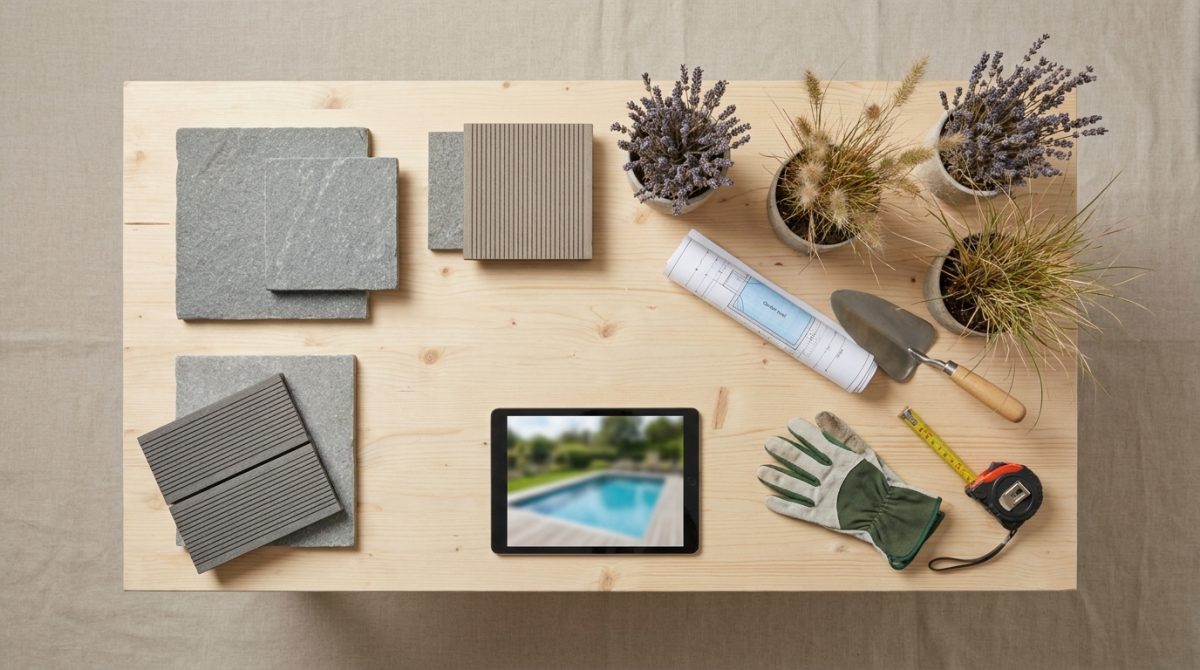
A private pool can be designed around how you actually want to live. Infinity edges, integrated lighting, natural stone surrounds, and landscaping that frames the water as a central feature of the garden are all achievable within a residential project. The pool becomes an extension of the home’s aesthetic rather than a functional box of water that sits apart from it.
Size is also genuinely flexible. The average domestic pool in the UK runs to roughly nine metres by four and a half metres, which is a comfortable lap-swimming length for most adults. But homeowners with smaller gardens are not excluded: compact pool solutions for modest plots have expanded significantly in recent years, making private ownership a realistic option for a much wider range of properties than was once the case.
The Practical Side: Maintenance and Running Costs
Maintenance is the aspect of private pool ownership that tends to attract the most scepticism, and it deserves an honest treatment. A pool does require time, chemicals, and either the knowledge to manage water chemistry yourself or the budget to have a specialist service it regularly. That is a genuine ongoing cost that public pool users do not face directly.
What comparing community and private pools on maintenance usually misses is that composite pools are substantially easier and cheaper to maintain than concrete or liner alternatives. The smooth, non-porous surface of a fibreglass composite shell does not harbour algae in the same way, requires fewer chemicals to maintain water clarity, and takes far less time to clean. For homeowners who want the benefits of a private pool without dedicating significant time to its upkeep, composite construction shifts the practical calculation considerably.
The edge case most new owners get wrong is water chemistry in the first few weeks after filling. A freshly filled pool takes several days to reach chemical equilibrium, and adding shock doses of chlorine without first testing total alkalinity and pH will push the water out of range in the other direction, forcing a second round of correction. The correct sequence is: test and adjust total alkalinity to 80 to 120 ppm first, then adjust pH to 7.2 to 7.6, then add chlorine. Skipping straight to chlorine is the single most common and most avoidable cause of early water clarity problems. A good pool installer will walk you through this on handover, but knowing the sequence in advance saves time and chemical costs from day one.
Running costs for heating and filtration vary with pool size, usage patterns, and specification, but modern heat pump technology has made year-round operation in the UK far more economical than it was a decade ago. A modern inverter-driven heat pump such as the Fairland TurboSilence series operates at a coefficient of performance above 10 in mild weather, meaning it produces more than ten units of heat for every unit of electricity consumed. Paired with a good pool cover to reduce heat loss overnight, a well-specified system running a nine-by-four-and-a-half metre pool typically costs between £600 and £1,200 per year in electricity, depending on how often the pool is used and how warm you keep it. That is not the energy drain it is sometimes assumed to be.
Who Is Making This Decision
Private pool ownership in the UK is not the preserve of a narrow demographic. The rise in demand is being driven by families who prioritise active leisure at home, homeowners in their forties and fifties who want a long-term wellness asset, and buyers in commuter belt locations where property values make the investment defensible. The broader shift toward home-based leisure, accelerated in recent years, has made the pool a far more mainstream aspiration than it once was.
Council leisure budgets will continue to face pressure. Some public pools will close; others will reduce their programming in ways that make them less useful for regular swimmers. That is not a criticism of the people managing those facilities, most of whom are doing their best with constrained resources. It is simply a structural reality that homeowners in a position to invest in private provision are increasingly weighing up.
The comparison between a community pool and a private one is not really about luxury versus economy. It is about whether you want access to swimming to depend on someone else’s budget decisions, or on your own investment in a permanent, warrantied, well-designed asset at home. For a growing number of UK homeowners, that question is becoming easier to answer.