
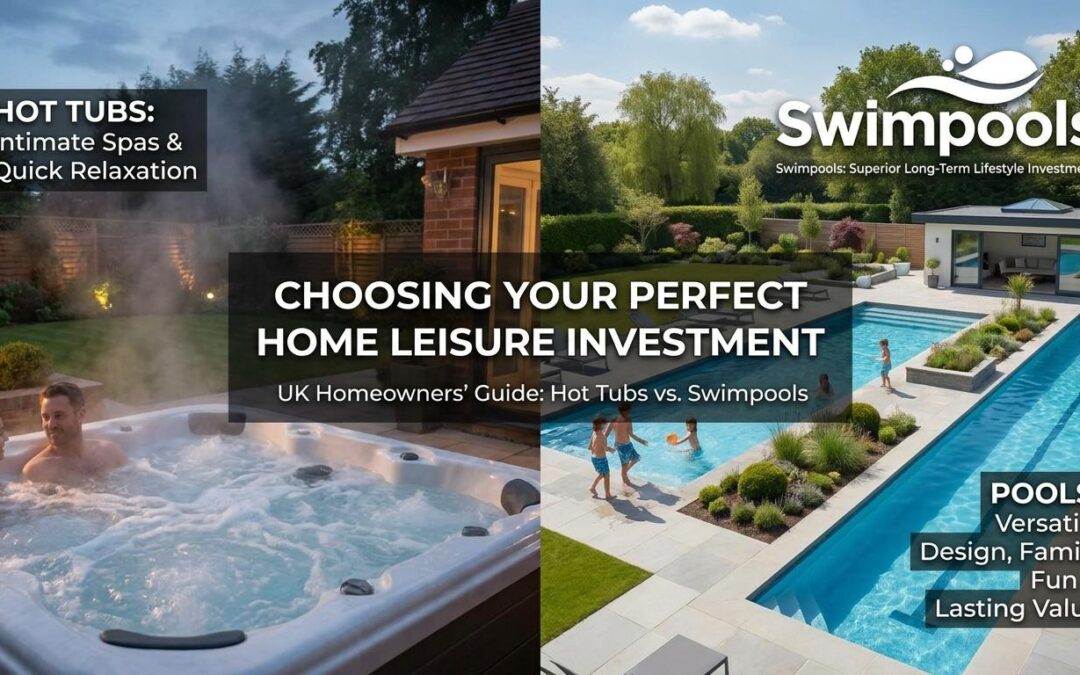
Most homeowners arriving at this decision underestimate how wide the gap is between products that all get called “water features.” A portable hot tub bought for under a thousand pounds and a fibreglass in-ground pool installed for sixty thousand pounds are not different points on the same scale. They are different infrastructure decisions, with different planning implications, different relationships to your property value, and different consequences if you get the choice wrong.
The number that sharpens thinking fastest: UK homeowners currently spend anywhere between £5,000 and £80,000 on a water leisure product. That range is not a sign of a confusing market. It is a signal that buyers are choosing between fundamentally different categories, and the frameworks they use to choose often do not match the scale of the commitment they are making.
Why the Stakes Are Higher Than You Think
The 2026 UK wellness market consolidation has shifted the conversation. Industry analysts tracking home wellness trends note that consumers are now treating home water features as long-term infrastructure investments rather than lifestyle accessories with a short shelf life. That shift matters because the evaluative criteria change entirely. You stop asking “will I enjoy this?” and start asking “will this still be the right product for my household in fifteen years, and what will it do to my property in the meantime?”
A poorly matched product choice costs more than the purchase price. It shapes the visual character of your outdoor space for every year you own the home. A bulky above-ground swim spa that made sense as a fitness tool in year one becomes a permanent aesthetic fixture that limits how you can use, landscape, or sell the garden. Conversely, a hot tub bought for entertainment can leave a family of four with nowhere to actually swim by the time children are old enough to want to.
Property value is not abstract here. A professionally installed in-ground pool can increase home value by 5 to 8 percent in the right market conditions. An above-ground hot tub typically adds nothing and sometimes complicates a sale when buyers factor in ongoing running costs they have not budgeted for. The gap between those two outcomes is not small on a £600,000 property.
This guide works through hot tubs, swim spas, and in-ground pools in deliberate order. Each section builds toward a decision framework rather than a list of pros and cons, because the real question is not “which product is best” in the abstract. It is which product fits a specific household’s space, budget, usage pattern, and long-term plans. The answer looks different for a couple in a townhouse than for a family with three children and half an acre.

What You Actually Get With a Hot Tub
Strip away the marketing and a hot tub is a precisely defined product. It holds between 1,000 and 1,500 litres of water, seats four to eight adults, and operates continuously at 37 to 40 degrees Celsius. That thermal consistency is the core engineering challenge the category has spent thirty years solving, and it is also the boundary that defines what a hot tub can and cannot do. It is, by design, a dedicated relaxation and hydrotherapy product.
The price range is enormous. Entry-level models, including the Lay-Z-Spa range that introduced millions of UK households to hot tub ownership, start below £1,000 and are inflatable or semi-rigid portable units. At the other end, premium brands like Jacuzzi and Bullfrog Spas reach £15,000 to £20,000 for top-specification shells. That gap in price reflects genuine differences in insulation quality, pump longevity, jet performance, and structural durability.
The Bullfrog Innovation Ceiling
Bullfrog Spas, founded in 1996 in Utah by Dave Ludlow, built their market position around the patented JetPak Therapy System. Rather than fixed jet placements moulded into the acrylic shell, JetPaks are interchangeable modules that can be repositioned to target different muscle groups, allowing owners to customise the massage experience over time without replacing the entire unit. It is a genuine engineering innovation, and it illustrates exactly where hot tub development has focused its energy: optimising the hydrotherapy experience within the fixed constraints of a heated soaking vessel.
That innovation is also, in a useful sense, a ceiling. The most sophisticated hot tub on the market in 2025 is still a product you sit in, not swim in. No patented jet system changes the 1,200-litre water volume or the 40-degree temperature that makes lap swimming physiologically impossible. The category has matured into an excellent version of one specific product.
Running Costs and the Warranty Reality
In the UK climate, running a quality hot tub typically costs between £50 and £100 per month in electricity. That figure climbs in poorly insulated models, particularly in winter, and falls with premium foam-filled cabinets and well-engineered covers. Over ten years, even at the lower end of that range, you are spending £6,000 on energy alone, on top of the purchase price and chemical costs.
The warranty terms on premium hot tubs deserve close attention before any purchase. Most manufacturers, including brands at the £15,000 to £20,000 price point, offer shell warranties of five years and component warranties of just two years. That means the pumps, heaters, control systems, and jet assemblies that make a hot tub worth buying are typically unwarranted after 24 months. For a product priced comparably to a quality used car, that is a significant exposure, and it is one of the sharpest contrasts with the warranty terms available on premium fibreglass pool shells.
The honest limitation of the category is straightforward: a hot tub cannot be used for lap swimming, cannot accommodate family pool games, cannot serve as the centrepiece of summer entertaining for more than five or six people at once, and cannot provide the aquatic exercise that growing children or fitness-focused adults need. It does what it does exceptionally well. The question is whether that is enough for your household for the next fifteen years.
The Swim Spa Middle Ground: Versatile but Compromised
The swim spa category exists to answer the question “what if I want more than a hot tub but cannot fit or afford a pool?” It is a genuinely useful product for specific households, and it is also a product that carries structural compromises that are worth understanding before committing.
A swim spa typically measures between 4 and 8 metres in length. The design combines a counter-current swimming zone, where a swimmer works against a mechanically generated flow, with either a separate or integrated hot tub seating area. The two zones serve different purposes and, in better-engineered models, operate at different temperatures simultaneously.
UK retail prices for quality swim spas run from roughly £12,000 to £35,000 installed, depending on size, manufacturer, and the complexity of the installation base required. That price range overlaps significantly with entry-level in-ground pool packages, which is worth holding in mind when the decision comes down to budget.
How the Counter-Current System Actually Works
The counter-current technology uses either propeller-driven systems or high-volume jet arrays to create a continuous flow that a swimmer moves against. The engineering quality here varies enormously across the market. Budget systems generate turbulent, uneven currents with dead spots and surface chop that disrupt stroke mechanics. A serious swimmer training on a poor system is not training effectively; they are fighting water disturbance as much as resistance.
At the top of the segment, engineering becomes genuinely impressive. BETA Wellness Riptide swim spas, for example, use a galvanised steel frame, corrosion-resistant stainless steel fixings, and up to 100mm of high-density foam insulation throughout. Their proprietary Spatech control system manages water temperature, jet performance, and scheduling from a single interface. That level of build quality addresses the durability and efficiency weaknesses that plague cheaper swim spas, but it also pushes the price toward the upper end of the range.
The Practical Swimming Reality
Here is the number that matters most for anyone buying a swim spa primarily as a swimming product: a 6-metre swim spa gives a swimmer roughly 1.5 to 2 effective stroke cycles before reaching the current zone boundary. That is workable for fitness training, where the goal is sustained resistance rather than open-water movement. It is actively unsuitable for anything else. Children cannot play freely in that space. Pool games require room to move laterally, which a swim spa does not offer. Entertaining a group of more than six adults becomes genuinely awkward.
The installation reality compounds the visual compromise. Swim spas are installed above ground or semi-recessed into a plinth or deck structure. Even the most attractively finished installation leaves a visible appliance in the garden rather than a water feature integrated into the landscape. A properly designed pool sits within the ground, framed by paving and planting, and becomes part of the outdoor living space rather than an object placed within it.
Running costs for a swim spa are higher than for a hot tub, for straightforward reasons. The water volume is larger, the dual-zone heating system works harder to maintain separate temperatures, and the counter-current pumps draw significant power during use. Monthly running costs in the UK typically fall between £80 and £150, depending on insulation quality, how often the current system is used, and ambient temperature across the seasons. Over a ten-year ownership period, that is between £9,600 and £18,000 in energy costs alone, before maintenance, chemical treatment, or component replacement.
Maintenance complexity is genuinely higher than a hot tub. A larger water volume requires more chemical management to maintain balance, the dual heating zones add potential failure points, and the counter-current mechanical components, propellers or high-volume pumps, require servicing that a basic hot tub does not. Factor that into the total cost of ownership before treating the purchase price as the primary comparison point.
The True Cost of Ownership Over 10 Years
Purchase price is the number everyone fixates on, and it is the least useful figure in the comparison. What actually matters is what each product costs you across a decade of ownership, including energy, chemicals, repairs, depreciation, and the value it does or does not add to your home. When you run those numbers honestly, the hierarchy shifts considerably.
Start with a mid-range hot tub at around 6,000 pounds. Monthly running costs in the UK typically sit at 80 pounds, driven by the energy required to maintain water temperature year-round. Add 300 pounds per year in chemicals and water treatment, and factor in one significant repair around year five, a pump or heater replacement that commonly runs to 1,500 pounds. Over ten years, that 6,000-pound hot tub costs approximately 19,100 pounds in total. That is over three times its sticker price.
Move up to a 25,000-pound swim spa. Running costs rise to around 120 pounds per month because you are heating a larger volume of water and running more powerful jet systems. Chemicals climb to 500 pounds per year. Routine component replacements across the decade, including jet cartridges, filters, and control boards, add around 2,000 pounds. Total ten-year cost: approximately 43,400 pounds. For a product that compromises on both the swimming and the soaking experience, that is a significant commitment.
Now consider a Leisure Pools composite in-ground pool installed by Swimpools. The entry point sits at around 45,000 to 60,000 pounds depending on size and specification. Monthly running costs fall in a similar range to a hot tub, 80 to 120 pounds, because a well-insulated composite pool with a heat pump and a cover is genuinely efficient. Chemicals run to around 600 pounds per year. Structural repair costs over the decade are near zero, because the composite shell carries a lifetime structural warranty and does not suffer the cracking, resurfacing, or liner replacement costs that other pool types routinely generate. Ten-year total: approximately 67,000 to 82,000 pounds depending on specification.

That figure looks large until you calculate per-use cost. A family using their pool four times a week for eight months of the year accumulates over 1,300 uses in a decade. Even at a total ownership cost of 75,000 pounds, each session works out at roughly 57 pounds. A family of four visiting a commercial leisure centre pays a comparable amount for a single admission. The pool delivers that experience at home, with no queues, no shared changing rooms, and no travel time.
The depreciation picture makes the comparison even clearer. A 15,000-pound hot tub is typically worth somewhere between 3,000 and 5,000 pounds after seven years. The second-hand market for used hot tubs is soft, spare parts become harder to source as models age, and buyers discount heavily for wear. A quality in-ground pool, by contrast, is cited by industry data as adding 5 to 8 percent to property value in favourable UK markets. On a 600,000-pound home, that is 30,000 to 48,000 pounds of added value working in your favour.
The ten-year lens does not make the pool cheap. It makes it the most cost-efficient per-use investment for an active family, and the only one of the three options that builds rather than destroys equity over time.
Why Composite Pool Construction Changes the Durability Equation
Most UK homeowners considering an in-ground pool are told they have three main options: concrete, vinyl liner, or fibreglass. What they are less often told is that each of those traditional materials carries specific, predictable failure modes built into it from day one. Composite technology was engineered specifically to eliminate those failure modes, and understanding the difference explains why a lifetime structural warranty is possible on one type of pool and simply not on the others.
The Problems With Concrete
Concrete pools, sometimes called gunite pools, are poured in place and are highly customisable in shape. That flexibility comes at a long-term cost. Concrete is rigid, and ground movement causes it to crack. This is not a rare event in the UK, where large portions of the country sit on clay-heavy soils that shrink in dry summers and swell in wet winters. Freeze-thaw cycles compound the stress. When a concrete pool cracks, water ingress accelerates the damage.
Beyond cracking, the plaster surface of a concrete pool degrades. Resurfacing is not optional maintenance that you can skip; it becomes structurally necessary. The cost typically runs from 8,000 to 15,000 pounds and the interval is usually every 10 to 15 years. That is a substantial unplanned expense that most concrete pool buyers do not factor into their original budget conversation.
The Problems With Vinyl Liner Pools
Vinyl liner pools solve the cracking problem by separating the water-holding function from the structural shell, but they introduce their own vulnerabilities. The liner itself requires replacement every 7 to 12 years at a cost of 2,000 to 5,000 pounds. It is vulnerable to puncture from pool toys, sharp objects, and even aggressive cleaning equipment. UV degradation makes the material brittle over time, and once a liner develops a tear, it needs replacing rather than repairing in most cases. There is also an aesthetic ceiling: liner patterns are limited, they can look dated as they age, and they do not photograph as cleanly as a gelcoat surface.
What Composite Construction Actually Involves
Leisure Pools, the manufacturer whose pools Swimpools supplies and installs in the UK, uses a proprietary composite construction process that bonds multiple structural layers into a single monocoque shell. The layering sequence starts with a UV-stable gelcoat that gives the pool its colour and provides the finished water-contact surface. Behind that sits a vinyl ester resin barrier specifically engineered to resist corrosion and osmotic blistering. Fibreglass reinforcement layers follow, and the structure is completed with a composite core that provides rigidity without brittleness. You can read more about the exact layer sequence on the pool technology page.
The result is a shell that behaves differently under stress than either concrete or vinyl. Rather than cracking under ground movement, the composite shell flexes slightly and returns. In the UK context, where clay soils shift seasonally and frost penetration can reach significant depths in northern England and Scotland, that flex tolerance is practically important. It is not a theoretical advantage on paper; it is the reason the shell can carry a warranty that concrete and vinyl pools simply cannot offer.
The Non-Porous Surface Advantage
The gelcoat surface of a composite pool is non-porous, and this has a measurable impact on day-to-day maintenance costs. Concrete pools have microscopically rough plaster surfaces that create ideal conditions for algae and bacteria to establish themselves in tiny pores. Owners of concrete pools routinely need higher chemical doses and more frequent shocking of the water to compensate. A non-porous composite surface gives algae and bacteria nowhere to anchor, which means lower chemical consumption and cleaner water with less effort.
There is also a structural engineering dimension that matters at the installation stage. Composite shell pools are manufactured to precise tolerances and their weight is distributed across the base and walls in a calculated, predictable way. This makes the installation process more controllable across varied ground conditions than pouring concrete in place, where curing time, ground moisture, and mix consistency introduce variability. For UK installers working across everything from London clay to Scottish sandstone, that predictability translates directly into more reliable results.
Design Versatility: The Dimension Hot Tubs Cannot Compete On
Hot tubs are manufactured products. You choose from a catalogue. The decisions available to you are which cabinet colour you prefer, whether you want more jets aimed at your shoulders or your lower back, and which LED lighting package to add. Swim spas extend that slightly, but the product remains fundamentally a rectangle of fixed dimensions built to a factory specification. Neither category offers genuine design latitude.
Leisure Pools offers over 40 distinct pool models across freeform, geometric, and plunge pool categories. At the compact end, models like the Olympus plunge pool suit gardens where space is the primary constraint, sitting at around 5 metres in length. At the other end of the range, resort-style pools exceed 12 metres and include integrated spa bays, tanning ledges, and splash zones within a single shell. The breadth of that range means a UK homeowner is not choosing between a pool and a spa as separate products; they are choosing a configuration that delivers both functions in one designed object.
Working with Swimpools, homeowners can specify internal colour from a professional gelcoat palette, choose bench seat positions and depths, include or exclude a tanning ledge, and decide whether to integrate a spa bay into the main shell or keep the pool purely for swimming and recreational use. These are not afterthought accessories bolted onto a standard product; they are engineered into the composite shell at manufacture, which means structural integrity is maintained across all configurations.
The UK climate objection to pool ownership is real, but it is answered by design rather than by settling for a swim spa. Swimpools offers bespoke enclosure options including retractable and telescopic structures that transform an outdoor pool into a year-round indoor-outdoor space. On a warm September evening the enclosure opens fully; on a February afternoon it closes and the pool becomes a covered, heated leisure environment. That flexibility does not exist for a hot tub or swim spa, which are either outside or inside with no middle ground.
Technology integration is another dimension where a pool installation moves well beyond anything a packaged hot tub can offer. LED colour-change lighting systems can shift mood from high-energy to calm across the full pool environment. Air source heat pumps integrate directly with pool control systems to manage water temperature intelligently, reducing running costs by heating when electricity is cheapest. Smartphone and poolside automation panels allow owners to pre-heat before they arrive home, schedule filtration cycles overnight, and adjust lighting from inside the house. A Leisure Pools installation becomes a managed wellness environment, not a static water feature that happens to be warm.
Landscape integration is worth taking seriously as a design consideration. A composite pool shell sits flush with its surroundings and can be bordered by natural stone coping, composite decking, planted beds, or a combination of all three. The visual result is a garden feature that looks designed, not installed. A rectangular swim spa cabinet in painted polymer, or a roto-moulded hot tub on a patio corner, cannot achieve that. The aesthetic ceiling matters beyond personal taste: a well-designed pool installation photographs as a premium outdoor living space and contributes to the presentation of the property when it comes to sale. A hot tub in the corner of a garden is a convenience item. A designed pool environment is an asset.
Heating, Running Costs, and the Year-Round UK Reality
The most persistent objection to pool ownership in the UK is the climate. Many homeowners assume they are committing to a seasonal amenity: something pleasant from late May to early September and then an expensive cover waiting for spring. That calculation is genuinely outdated, and it is worth understanding why.
An air source heat pump paired with a well-insulated composite pool can maintain water temperature between 28 and 30 degrees Celsius throughout the year. Operating costs for a setup like this typically run between 80 and 120 pounds per month, a figure that surprises most people because it sits squarely in the same range as running a quality swim spa. The efficiency comes from the heat pump’s coefficient of performance: for every unit of electricity consumed, a modern heat pump delivers three to four units of thermal energy into the water.
A pool enclosure takes that efficiency considerably further. Industry thermal modelling consistently shows that an enclosure reduces heat loss by up to 75 percent compared to an open pool surface exposed to UK ambient temperatures and wind. That is not a marginal gain. It directly translates into lower monthly heating bills and extends comfortable swimming to all twelve months of the year, not as a theoretical possibility but as a practical everyday reality.

Hot tubs do not escape the cost problem simply by being smaller. They maintain temperature continuously, which means the heating element cycles on and off around the clock regardless of whether anyone is using the tub. A poorly insulated hot tub in a UK winter can consume between 200 and 300 pounds per month in electricity. The insulation quality varies enormously between manufacturers, and entry-level models frequently perform badly here. The ongoing cost is not always made clear at the point of sale.
Swim spas benefit from having a smaller water volume to heat, which does give them an efficiency advantage over an uncovered, unenclosed pool. But the dual-zone design found in most premium swim spa models means two separate heating circuits running simultaneously whenever both the swim zone and the spa zone are in use. That combined load erodes the efficiency argument considerably during the exact usage pattern the dual-zone design is intended to support.
The combination of a Leisure Pools composite shell with a properly specified enclosure and a heat pump represents the most energy-efficient route to year-round aquatic use at the scale that can accommodate a family. The running costs are manageable rather than punitive, and the investment in heating infrastructure pays back through twelve months of genuine usability rather than a six-month season.
Health, Fitness, and Lifestyle: Matching Product to Purpose
Any honest comparison has to acknowledge what hot tubs do genuinely well. The hydrotherapy case for a quality hot tub is solid and well-documented. A 20-minute soak at 38 degrees Celsius raises core temperature, promotes muscle relaxation, dilates peripheral blood vessels, and has measurable effects on sleep onset. For people managing joint pain, recovering from injury, or dealing with chronic stress, a hot tub delivers real clinical benefit in a compact, accessible format.
Swim spas extend the offer into cardiovascular territory. Counter-current resistance swimming is effective exercise: low-impact on joints, adjustable in intensity, and usable year-round. The limitation is structural. The current zone in a swim spa is fixed, the swimmer stays stationary relative to the shell, and only one person can train in the current at a time. That makes it functionally similar to a treadmill in water: genuinely useful for solo fitness, but monotonous over time and unable to support group activity or varied training formats.
A full pool of 10 metres or more changes the proposition entirely. Lap swimming, aqua aerobics, children learning stroke technique, teenagers playing water polo, and toddlers in the shallow end can all happen simultaneously without any one use competing with another. No other product delivers that range. It is the only option that scales with a family across different ages and across different fitness goals as those goals evolve over a decade or more.
The design flexibility of the Leisure Pools range addresses one of the most common trade-off arguments head-on. Several models include an integrated spa bay within the pool shell itself. The Limitless design, for example, combines a splash pad, a dedicated spa zone, and a main pool body in a single compact shell. A homeowner gets the hydrotherapy benefit associated with a standalone hot tub without choosing between relaxation and recreation, and without maintaining two separate bodies of water.
It is worth being direct here: for a solo retiree whose primary goal is managing arthritis or improving sleep, a high-quality hot tub at a fraction of the capital cost may be entirely the right answer. This comparison is not making the case that a pool wins in every scenario. What it is making clear is that for a family with adequate outdoor space and a long-term outlook, no other product comes close to delivering equivalent lifestyle range. A hot tub cannot accommodate a swimming lesson. A swim spa cannot accommodate four people playing freely in the water. A pool can do both.
Swimpools’ consultation process starts with lifestyle mapping for exactly this reason. A 10-metre geometric pool is the wrong answer for a solo retiree just as a hot tub is the wrong answer for a family of five who want to use their garden investment in as many different ways as possible across as many years as possible. Getting that match right is what the initial consultation is designed to do.
Installation Realities in the UK: Planning, Ground, and Timeline
Hot tub installation is the most straightforward of the three options. The core requirements are a reinforced concrete base, a dedicated electrical circuit typically rated between 32 and 63 amps depending on the model, and a qualified electrician to connect it. Once the concrete pad has cured, the tub itself can be delivered and connected in a single day. The total groundwork is minimal, the disruption is short-lived, and the barrier to entry is low.
Swim spa installation follows a similar pattern but the larger footprint and considerably greater weight mean that a standard delivery vehicle and two-person team are rarely sufficient. Positioning a swim spa in a rear garden often requires a crane or a telehandler, which adds between 500 and 1,500 pounds to the total delivery and placement cost depending on site access and the equipment required. That cost is not always included in the headline price, so it is worth asking the question explicitly before committing.
In-ground pool installation is a different category of project entirely, and it is worth being straightforward about that. The process involves initial site survey, excavation, preparation of the base and backfill, positioning the composite shell, installing the concrete collar that locks the shell in place, plumbing the circulation and filtration system, running electrical connections to pumps and controls, and finally reinstating the surrounding landscaping. From breaking ground to a filled, commissioned pool, a realistic UK timeline is 6 to 12 weeks. The variation depends on ground conditions, weather, and the complexity of the surrounding landscaping.
Planning permission is not required for most in-ground pool installations in England and Wales. Pools generally fall under permitted development provided the project is within the curtilage of a dwelling house, not in a designated area such as a national park or Area of Outstanding Natural Beauty, and that ancillary equipment does not exceed height restrictions. Swimpools works through this assessment with clients as a standard part of the project scoping process, so homeowners are not left to navigate planning policy alone.
Ground conditions in the UK vary considerably, and clay soils in particular require careful management during installation. Clay shrinks and swells seasonally, which creates lateral pressure on rigid structures. The flexibility inherent in a composite shell is an engineering advantage in this context: it can absorb minor ground movement without cracking in the way that a traditional concrete pool shell cannot. Swimpools conducts a site survey before specifying the installation method, partly to confirm that the chosen shell and installation approach are right for the ground conditions on that specific plot.
The timeline and physical disruption of pool installation is a genuine cost that hot tub buyers do not face. A fortnight of excavation equipment in the garden, reinstatement work, and the general upheaval of a building project is a real factor to weigh. But it happens once. The lifetime structural warranty on a Leisure Pools composite shell means the shell itself should never need to be dug out and replaced. That one period of disruption is the price paid for a permanent installation that carries no structural replacement cost for as long as the home stands.
Making the Decision: A Framework Built Around Your Household
Every conversation about hot tubs, swim spas, and pools eventually arrives at budget, and budget is the wrong place to start. The more useful lens is household profile: who uses the water feature, how often, for what purpose, and for how long. Get those four variables right and the budget question almost answers itself.
The four variables worth working through honestly are available outdoor space, number of regular users, primary use case, and intended tenure in the property. A couple who move every five years have a completely different calculation from a family who have just extended the kitchen and are planning to stay for twenty. Neither answer is wrong, but they point toward very different products.
When a Hot Tub Is the Honest Recommendation
For a couple with a compact courtyard garden, a budget under £10,000, and a primary goal of evening relaxation after work, a quality hot tub is the right answer. Full stop. A garden that cannot accommodate an in-ground pool should not try to force one, and no reputable retailer should talk that household into a product that does not fit their space or their life. A well-specified hot tub from a brand with a decent shell warranty will deliver exactly what that couple needs, and it will do so without overcapitalising on a small outdoor footprint.
When a Swim Spa Earns Its Place
For a fitness-focused household with a narrow garden, a budget in the £20,000 to £35,000 range, and a primary goal of daily exercise, a premium swim spa with a strong counter-current system is a credible and practical choice. The key qualifier here is the counter-current system: a swim spa that cannot generate a genuinely challengeable current for a competent swimmer is essentially a very expensive hot tub with a longer footprint. If daily fitness swimming is the brief, the counter-current specification deserves as much scrutiny as any other feature before money changes hands.
When an In-Ground Composite Pool Is the Only Product That Makes Sense
For a family with a garden of 80 square metres or more, a budget that can stretch to £45,000 and above, and a goal of multi-generational daily use over 15 years or longer, an in-ground composite pool is the only product that grows with the household rather than limiting it. A swim spa serves two adults swimming in rotation; a pool serves children learning to swim, teenagers using it with friends, adults doing lap sessions, and guests at a summer gathering, all on the same afternoon. That breadth of use is not something any spa product can replicate.
The Warranty as an Engineering Statement
The warranty comparison is not a marketing abstraction. A Leisure Pools lifetime structural warranty, available through Swimpools, reflects the engineering confidence behind a composite fibreglass shell that is built to last the life of the property. A typical hot tub shell warranty runs to five years. That gap is not arbitrary; it reflects the material science, the manufacturing process, and the realistic lifespan of each product. When you are deciding between products at similar price points, or choosing how far to stretch your budget, that warranty differential is a legitimate and concrete factor in the decision.
What Swimpools’ Consultation Process Actually Looks Like
Swimpools offers a consultation and design service that starts with a garden survey and a lifestyle brief. From there it moves through pool selection, enclosure specification, and equipment packages before any financial commitment is made. That sequencing matters. It means the design is built around your actual garden dimensions and your household’s actual habits, not around a showroom model that happened to be available. If you want a pool with a full enclosure for year-round swimming, that gets costed properly from the start rather than added as an afterthought six months later.
The Last Thing to Hold Onto
A hot tub is a product that depreciates in your garden. It loses value from the day it is installed, the components age, and by year ten most models are approaching end of life. A quality in-ground pool is infrastructure. Research consistently points to a professionally installed in-ground pool adding 5 to 8 percent to residential property value in markets where outdoor leisure space is valued, and the UK market for family homes with private pools has been moving in that direction for years. That uplift, combined with daily use across decades, is a combination no spa product can replicate.
The decision, framed properly, is not about which product is cheapest or which brochure looks best. It is about which product fits the household you actually have, serves the life you actually live, and holds its value in the ground long after the novelty of ownership has settled into something better: routine.