
A spa that turns green within days of a “professional clean” is not just inconvenient. It is a warning sign that something has gone seriously wrong, either with the work carried out or with the contractor you trusted to carry it out. For new pool owners still finding their feet, that situation can be both costly and deeply frustrating, especially when the contractor’s response is to immediately point the finger at your equipment.
Protecting a premium pool investment means knowing how to choose the right maintenance professional from the start, understanding what good service actually looks like, and being confident enough to challenge shoddy work when you see it.
Why Proper Vetting Matters More Than You Think
Hiring a pool maintenance contractor without a structured vetting process exposes you to real risk: chemical mismanagement, equipment damage, and in some cases, pool water safety failures that put your family at risk. Unlike many trades, pool maintenance sits in a lightly regulated space in the UK, so the responsibility for checking credentials falls largely on you as the homeowner.
The Pool and Hot Tub Alliance sets widely recognised standards for pool professionals, including technician certification programmes. Asking a prospective contractor whether their staff hold any recognised industry qualification is a perfectly reasonable first question, and any competent professional will welcome it.
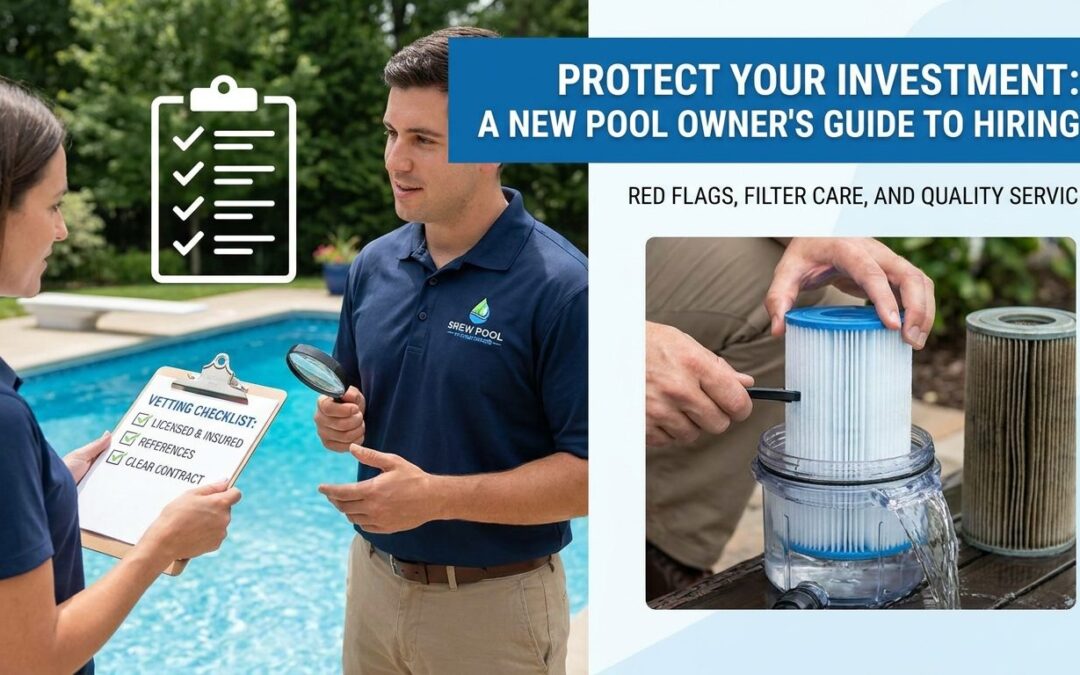
Before you sign anything or hand over access to your pool, work through a checklist like this one:
- Ask for proof of public liability insurance (minimum £2 million cover is typical for trade work on residential properties).
- Request references from at least two current clients with a similar pool type to yours.
- Confirm whether the technician who attends will be the same person each visit, or a rotating rota of staff.
- Ask what industry qualifications or training their technicians hold.
- Check whether they carry a written service log and whether you will receive a copy after each visit.
- Clarify what is and is not included in the quoted price, especially filter maintenance and chemical dosing.
A contractor who hesitates, deflects, or cannot answer these questions confidently is worth walking away from, regardless of how competitive their quote looks. Our guide to choosing a pool service partner goes deeper on this process if you want a fuller framework.
What a Proper Filter Clean Actually Involves
Filter maintenance is one of the most consequential tasks in pool care, and it is also one of the easiest for a dishonest or lazy contractor to skip. If your pump performance drops shortly after a supposed filter service, trust your instincts.
There are three main filter types found in residential pools in the UK: sand filters, cartridge filters, and diatomaceous earth (DE) filters. Each requires a different cleaning process, and a competent technician should be able to explain clearly which type you have and exactly what they did.
For a sand filter, a proper service involves backwashing until the sight glass runs clear, followed by a rinse cycle. A thorough annual deep clean uses a sand filter cleaner chemical that breaks down oils and scale the backwash cycle cannot remove.
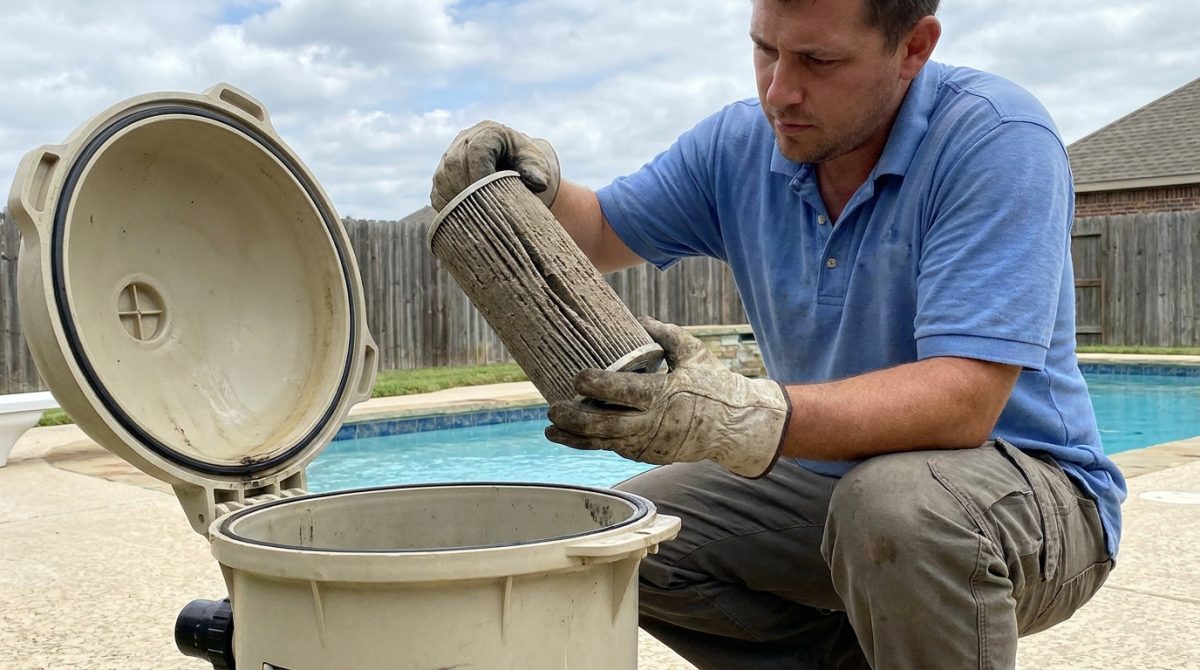
For a cartridge filter, the cartridge should be removed, rinsed under a hose at low pressure to clear debris, soaked in a filter cleaning solution for at least several hours, rinsed again, and inspected for tears or damage. Simply hosing it down and reinserting it is not a complete service.
For a DE filter, the process is the most involved. The filter grids need to be removed, rinsed, inspected for tears, soaked in a cleaning solution, and fresh DE powder added on reassembly. If a contractor tells you they have cleaned your DE filter but cannot describe this process in detail, and your pump flow rate is noticeably weaker afterwards, there is every reason to suspect the work was not done properly.
Red Flags During and After a Service Visit
Some warning signs are obvious on the day. Others only emerge over the days that follow. Either way, knowing what to look for means you are not relying solely on a contractor’s word.
Watch out for these during or immediately after a visit:
- The technician spends less than 30 minutes on site for a visit that was supposed to include a filter clean and chemical check.
- You are not shown or given a written record of the chemicals added, in what quantities, and the water test results before and after.
- The contractor is vague or contradictory when you ask what they actually did.
- Equipment panels are left open, valves are in the wrong position, or connections look disturbed without explanation.
And watch for these in the days that follow:
- Noticeably weaker flow from jets or spillways, which suggests a filter that was not cleaned or was reassembled incorrectly.
- Water clarity deteriorating within 48 to 72 hours of a chemical service.
- Spa or shallow end water turning green, which points to an algae bloom driven by poor chemical balance or compromised circulation.
- Pump running louder or cycling on and off more frequently than usual.
If a contractor’s immediate response to any of these concerns is to blame your equipment rather than investigate their own work, that in itself is a red flag. A good professional will want to come back, test the water, check the filter assembly, and rule out their own work before pointing elsewhere.
Documentation: Your Best Defence
One of the most practical things you can do as a pool owner is insist on written service records from day one. A proper service log should record the date, the technician’s name, every task completed, water test readings before and after, chemicals added with quantities, and any equipment observations. Without this, you have no baseline to compare against and no evidence if a dispute arises.
According to pool service vetting guidance, structured documentation is one of the clearest markers that separates professional operators from informal ones. Ask for a copy of the service log after every single visit. If the contractor cannot provide one, or provides something vague like “cleaned and checked, all fine”, that is not adequate record-keeping for the level of investment a premium pool represents.
You should also keep your own simple log. Note the date of each visit, what you observed in terms of water clarity and flow, and any issues you raised. If a problem develops and you need to establish a timeline, your own notes can be invaluable.
When to Take Action and When to Switch Contractors
Raising concerns politely once is fair. A good contractor will take them seriously, investigate, and put things right. But if you raise the same concern twice and get deflection, excuses, or a defensive response each time, you are dealing with someone who either does not know what they are doing or does not care.
Give any new contractor a reasonable settling-in period, perhaps two or three visits, before drawing firm conclusions. But if water quality is consistently poor, equipment performance is declining, or you simply cannot get straight answers about what was done, trust your judgement and look elsewhere. The costs of ongoing poor maintenance compound quickly: algae treatments, equipment repairs, surface damage, and potentially a full drain and clean are all far more expensive than finding a better contractor sooner.
For more detail on planning longer-term service schedules and annual inspections, our guidance on pool maintenance planning covers the year-round picture in full.
Setting Expectations from the First Conversation
The best time to establish standards is before the first visit, not after a problem has already developed. Tell any prospective contractor upfront that you expect a written service report after every visit, that you want water test readings included, and that you will be asking questions if equipment performance changes following a service.
A confident, capable professional will respond positively to this. They know that transparent documentation protects them as much as it protects you. Someone who bristles at the idea of accountability is telling you something important about how they work.
Premium pool ownership is a significant investment. The pool itself, the equipment, the surrounding landscaping, and the years of enjoyment it should provide all depend on maintenance being done properly and honestly. You are entitled to expect exactly that from anyone you pay to look after it.