
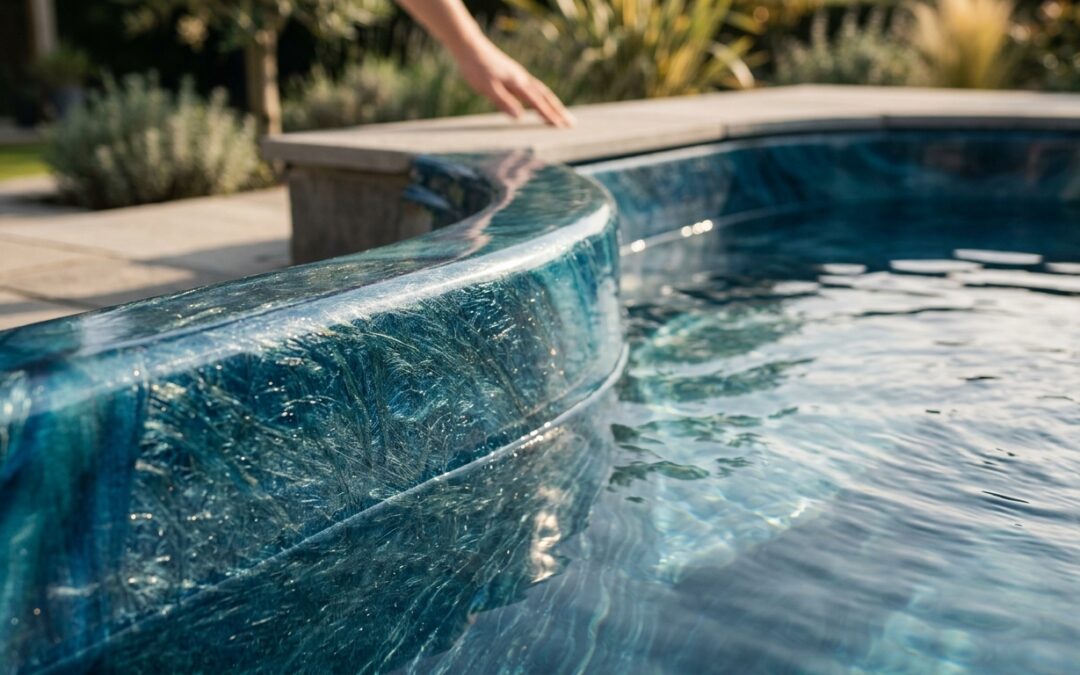
When a pool company talks about a ‘composite shell’, it can sound like marketing shorthand. But there is real engineering behind the term, and understanding it even at a basic level will help you ask better questions, compare products more confidently, and know exactly what you’re getting for your money.
What a Composite Actually Is
A composite material is made by combining two or more distinct materials that, working together, perform better than either one could on its own. Think of reinforced concrete: steel and concrete are both useful separately, but together they handle both tension and compression in ways neither manages alone.
In pool construction, the composite in question is a fibre-reinforced polymer (FRP). The two key components are:
- Reinforcing fibres (usually fibreglass, and in premium shells, layers of woven or chopped strand material alongside structural fabrics)
- A resin matrix that binds those fibres together and transfers loads across the structure
Neither element alone gives you a pool shell. The fibres are strong in tension but need the resin to hold them in position and spread stress evenly. The resin gives shape and surface quality but would crack under load without the fibre reinforcement. Together, they create something rigid, watertight, and remarkably light for its strength.
The Role of the Fibres
Fibreglass is the workhorse of composite pool construction. Individual glass filaments are extremely strong in tension, and when arranged in layers they give the shell its structural backbone. The direction in which those fibres are laid matters a great deal: random chopped strand provides general stiffness, while woven or stitched fabrics allow engineers to place strength exactly where a shell needs it most, around the steps, the rim, the floor.
Premium manufacturers go further than a basic spray-up process. Rather than simply spraying chopped fibres onto a mould, they build up the shell in deliberate laminate schedules, alternating fabric types and resin applications to achieve consistent thickness and controlled mechanical properties throughout. This is where budget shells and premium shells start to diverge noticeably.
Why Resin Quality Is Not a Small Detail
The resin is the continuous phase in the composite, meaning it surrounds and bonds every fibre. Its quality determines how the shell handles water absorption, UV exposure, thermal cycling, and chemical contact over a lifetime of use.
Isophthalic polyester and vinyl ester resins are common in quality pool shells. Vinyl ester in particular offers excellent resistance to the osmotic blistering that has plagued older fibreglass pools, because it absorbs water far more slowly and maintains its bond with the fibres under prolonged immersion. A pool shell that uses a high-grade resin system and an appropriate gelcoat will stay structurally sound and visually consistent for decades, not just seasons.
How This Compares to Older Construction Methods
Before composite pools became the standard for quality residential installations in the UK, the main alternatives were concrete (gunite or shotcrete) and liner pools over a steel or polymer frame. Each has well-known drawbacks.
- Concrete pools are heavy, porous, and require acid washing, resurfacing, and significant ongoing chemical use to stay manageable. They can crack as ground conditions shift, and repairs are invasive.
- Liner pools are more affordable upfront but the liner itself needs replacing every eight to twelve years on average. The join between the liner and fittings is a recurring source of leaks, and the aesthetics are limited.
Composite shells sidestep both sets of problems. The gelcoat surface is non-porous, so algae has far less to cling to and chemical demand drops noticeably. The shell is manufactured off-site in a controlled environment, arrives as a single piece, and does not rely on a separate membrane to stay watertight.
The Strength-to-Weight Advantage
One of the most useful properties of fibre-reinforced composites is their high strength-to-weight ratio. A composite pool shell is substantially lighter than an equivalent concrete structure, which simplifies installation, reduces the load on surrounding ground, and makes craning the pool into position far more straightforward.
This is not just a logistical convenience. A lighter shell places less stress on the excavation walls during installation and gives more flexibility in gardens where access is restricted. For many UK properties with narrow side access or compact rear gardens, a composite shell can be installed where a concrete pool simply could not.
What Makes a Premium Composite Shell Stand Apart
Not all composite pools are built to the same standard. A few things separate a genuinely premium shell from a basic one:
- Laminate schedule: how many layers are applied, in what order, and whether the process is controlled manually or relies on spray-up alone
- Resin specification: whether a blister-resistant resin system is used throughout, not just at the surface
- Structural reinforcement: additional material around high-stress areas such as steps, ledges, and the pool rim
- Gelcoat quality: the outer surface finish affects both aesthetics and long-term resistance to UV fading and surface etching
- Manufacturing environment: temperature and humidity-controlled production ensures consistent cure and reduces the risk of voids or delamination
Leisure Pools, whose shells Swimpools supplies in the UK, uses a composite construction process that incorporates multiple reinforcement layers and a high-grade resin system, backed by a lifetime structural warranty. That warranty is only possible because the manufacturer has confidence in what the laminate will do over decades of real-world use.
What This Means for You as a Buyer
Understanding the basics of composite construction gives you a framework for evaluating what you’re being sold. When comparing pool shells, it is worth asking suppliers directly about their laminate process, the resin system used, and what the structural warranty actually covers.
A premium composite pool is not just a hole in the ground with a nice finish. It is a precisely engineered structure designed to hold tens of thousands of litres of water, resist ground movement, handle constant chemical exposure, and look good doing it for the better part of your lifetime. The materials at its core are what make that promise credible.