
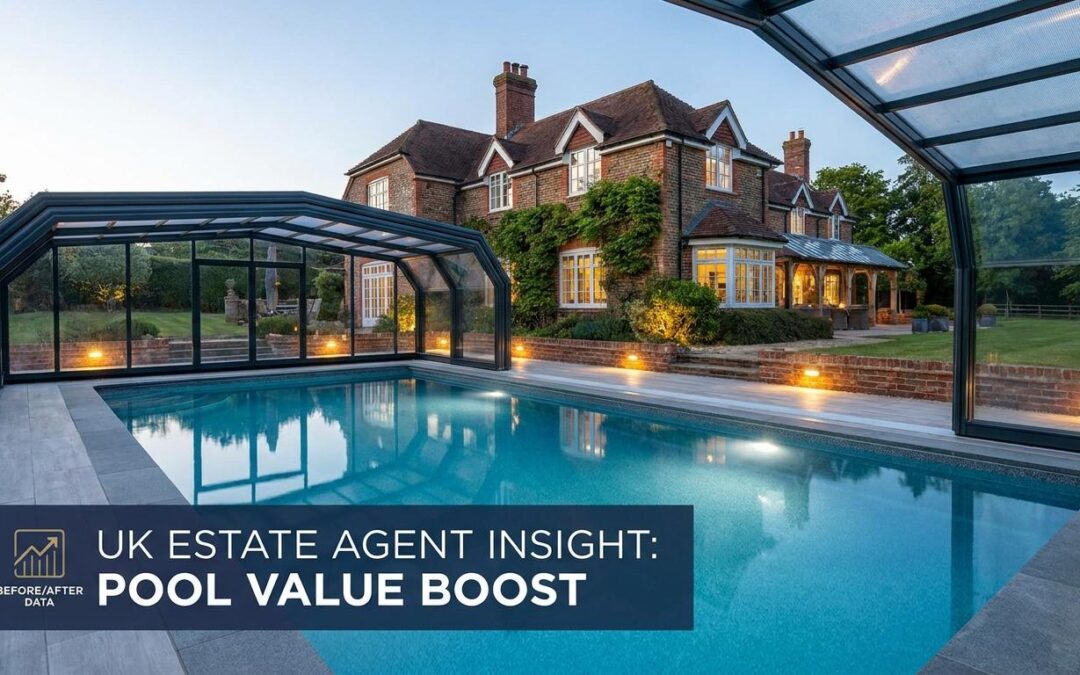
Most homeowners who install a swimming pool do it for the obvious reasons: somewhere for the children to spend August, a reason to stay home rather than book a villa abroad. What they often discover later is that the pool has quietly done something useful to the property’s value, particularly when they come to sell. The numbers are not uniform, and they depend heavily on construction quality, presentation, and the local market, but the direction of travel is consistent. Done well, a pool shifts a property into a different conversation.
The key word is ‘done well’. An overgrown concrete trough with a rusting ladder reads as a liability. A clean composite installation with a well-fitted enclosure reads as a lifestyle statement. The difference between those two outcomes is largely a question of specification and material choices, which is why understanding how pools are built matters as much as whether to build one at all.
Why the UK Property Market Has Started Taking Pools Seriously
The pandemic years changed what British buyers put on their non-negotiable list. Outdoor space, usable gardens, and private leisure facilities moved from ‘nice to have’ into active search criteria for a significant slice of the market. What is less obvious is that this shift has not reversed as restrictions ended. Estate agents and property data consistently show that premium buyers in the South East, the Home Counties, and the wider commuter belt continue to weight outdoor leisure infrastructure heavily. The pool, specifically, has gone from an unusual luxury to a recognised and expected feature at the top end of certain local markets.
You can see this in how agents from firms like Knight Frank and Savills structure their aspirational listings. Pools appear on spec sheets and in lead photography across Surrey, Kent, Hertfordshire, and Buckinghamshire with a regularity that would have seemed unusual fifteen years ago. These are not anomalies or vanity features. They are properties where the seller and the agent have made a calculated decision that the pool is a selling line, not a footnote.
At peak pandemic demand, analysis cited by the New York Post found that pool ownership was boosting home values in some US markets by as much as 54 percent. The UK figure is considerably more conservative, but it is measurable. Properties in the right bracket, in the right location, with a quality installation, consistently attract premiums over comparable non-pool homes. The mechanism is partly rational and partly emotional, which is actually what makes it durable rather than cyclical.

The perception shift matters too. For a long time, British buyers approaching a property with a pool did a quick mental calculation and arrived at ‘maintenance headache’ before they had even opened the gate. That default reaction has softened considerably, particularly for homes priced above £750,000. At that price point, buyers are not looking for reasons to avoid the pool. They are looking for reassurance that it is well built, warrantied, and will not generate a remedial bill in the first three years of ownership.
This article traces that story in specific terms. It looks at what estate agents actually report when a pool appears on the spec sheet, which construction technologies are driving the most positive valuations, where the real uplift numbers sit for UK properties, and which homes are the strongest candidates for pool investment. The goal is a clear, evidence-based picture rather than aspirational generalities.
What Estate Agents Actually Say When a Pool Is on the Spec Sheet
The phrase that comes up repeatedly among agents working in Surrey, Kent, and comparable markets is ‘lifestyle anchor’. It describes a feature that causes a buyer to make an emotional commitment to a property before they have worked through the rational checklist: how far is the station, what are the school catchments, does the boiler need replacing. A pool, presented well, can anchor a buyer psychologically in a way that a large garden or a recently renovated kitchen rarely manages to replicate.
The practical effect of this is that agents in active pool markets report a clear difference in buyer behaviour. A well-presented outdoor pool with a modern composite shell and a clean enclosure moves a property from the second-viewing pile to the first-call list, particularly for families with children. The pool is not just a feature. It is a vision of a specific kind of life, and buyers who have that vision do not need as much convincing on the other details.
The Price Bracket Question
Agents are careful to situate this effect in its correct price context. A pool adds the most measurable value when the property is already in the top 15 percent of its local price bracket. Below that threshold, a pool can feel incongruous, and buyers at lower price points are more likely to factor running costs as a deterrent rather than a feature cost they can absorb. Above it, buyers expect the premium and are generally well positioned to manage ongoing maintenance.
Swimpools’ own market analysis of Mansfield and Ashfield listings found measurable price premiums for properties with pools compared to comparable homes on the same streets without them. This is a more modest market than Surrey or Hertfordshire, which makes the finding more interesting, not less. It suggests that the pool premium is not purely a function of the South East market or ultra-prime property. Where the installation is modern, maintained, and well-presented, the uplift appears across a broader range of markets than is often assumed.
What Suppresses Value Versus What Commands It
Agents draw a sharp and consistent distinction between old and new pool types. A tired concrete pool with cracked surrounds, faded water line tiles, and visible algae staining does not just fail to add value. It can actively suppress it. Surveyors flag it, lenders note it, and buyers who might otherwise be interested start calculating the cost of remediation rather than the enjoyment of ownership. The estimated cost of resurfacing a concrete pool can range from £8,000 to well above £20,000 depending on size and condition, and that figure tends to surface in negotiation.
A modern composite installation with a well-fitted enclosure, by contrast, presents as a finished, functional amenity with a visible quality signal. There is no cracking to flag, no visible surface degradation, and the enclosure confirms that the pool is not just a summer feature but a year-round facility. Agents in South East markets report that this combination shortens the sales timeline and strengthens the negotiating position of the seller.
Staging and Listing Photography
One specific area where agents are particularly direct is listing photography. Around 80 percent of first contact decisions are driven by online listing photos, which means the pool needs to photograph well or it is invisible as a selling point. Agents advise the following as standard practice before a shoot:
- Water should be clear and a consistent blue, with chemical balance checked the week before photography
- Pool lighting should be activated, ideally for a dusk or early evening shot that shows the water in the best light
- Enclosure glass should be cleaned inside and out, removing any condensation marks or algae trails from the frame
- Surrounding paving and planting should be freshly cleared, with no debris in the water or on the pool surrounds
These are not complex interventions, but they are frequently overlooked. A pool that looks blue and inviting in a listing photograph does a different job than one that looks slightly green and untended. The former confirms the feature’s value. The latter raises questions about ongoing maintenance and hands buyers a reason to reduce their offer.
The Composite Advantage: Why Construction Technology Changes the Valuation Conversation
When a surveyor looks at a swimming pool during a residential valuation, the question they are really asking is: will this feature require significant remedial expenditure in the near to medium term, and if so, how much? The answer to that question changes entirely depending on what the pool is made of.
Concrete pools age in ways that are visibly and structurally significant. The surface absorbs water, minerals, and chemical residue over time. Cracks develop as the ground moves seasonally, particularly in the clay-heavy soils common across much of the South East. The interior surface, whether painted or tiled, typically requires resurfacing every 10 to 15 years, with costs that commonly fall between £8,000 and £25,000 depending on pool size and the extent of deterioration. A surveyor who has seen enough concrete pools knows this schedule, and it becomes a material point in the valuation.
Composite fibreglass pools work differently at a structural and surface level. Manufacturers like Leisure Pools build shells using a multi-layered construction process that combines fibreglass reinforcement with a non-porous interior surface. That non-porous surface, which Leisure Pools calls the Aquaguard interior, does not absorb water, does not develop the mineral staining common in concrete, and is structurally stable across decades rather than across the 10 to 15 year concrete resurfacing cycle. There is no painted or tiled surface to degrade, no grout to harbour algae, and no cementitious matrix to crack under ground movement.
The Warranty as a Transferable Asset
Leisure Pools backs its composite shells with a lifetime structural warranty, and the specific detail that matters in a property transaction is that this warranty is transferable. When a home with a Leisure Pools composite shell sells, the buyer inherits the warranty. This is not a minor administrative point. It removes one of the two largest objections that lenders and surveyors raise when a pool appears on a valuation: the question of long-term structural integrity. A transferable lifetime structural warranty answers that question in a way that no concrete pool, regardless of its current condition, can replicate.
For buyers who plan to use a mortgage to purchase the property, this matters practically. Lenders are more comfortable with pool features that carry documented manufacturer warranties than with features whose condition depends entirely on the maintenance history provided by the seller. You can read more about long-term pool investment and what durability specifications mean for resale value in the context of UK property transactions.
Running Cost Differential and Its Effect at Point of Sale
The non-porous Aquaguard surface also changes the ongoing chemical cost profile of the pool. Because the surface does not absorb chemicals the way a porous concrete interior does, less chemical input is required to maintain correct water balance. The typical saving is in the range of 30 to 40 percent on chemical costs compared to a comparable concrete pool. Over a year of operation, this is not a trivial difference, and it is one that a well-prepared seller can present to buyers as documented evidence of lower running costs.
Lower chemical demand also means fewer visible maintenance issues at point of sale. A concrete pool that has been slightly under-dosed through a winter will often show surface staining, algae traces at the waterline, or tile discolouration. A composite pool in the same situation is far more forgiving, partly because there is no porous surface to stain and partly because the smooth Aquaguard interior makes any residue easier to remove before a viewing.
The Longevity Argument
Perhaps the most important point for anyone thinking about pool investment in the context of future resale is this: a composite pool installed today looks nearly identical at year 15 compared to year one. The colour holds, the surface integrity holds, and the structural shell shows none of the visible degradation that is common in concrete pools at the same age. Vinyl-liner pools, which are cheaper to install but require liner replacement every 8 to 12 years at costs typically between £2,000 and £5,000, also fail this test.
The practical consequence is that a composite pool supports a sustained valuation uplift over the life of the property, rather than a declining one. A concrete pool that added value in year one may have eroded much of that premium by year 12, as its condition becomes a visible issue. A composite pool in year 12 is still presenting as a modern, functional amenity. Swimpools positions this longevity as the defining reason composite construction changes the valuation conversation. The analogy to glazing technology is a useful one: the shift from single to triple glazing did not just improve thermal performance, it changed how buyers and surveyors read the quality signal of the whole property. A composite pool does something similar for outdoor leisure infrastructure.
Case Study: A Surrey Family Home That Sold 18 Percent Above Guide
The numbers here are specific, and they matter. A four-bedroom detached home in a commuter village south of Guildford had previously been tested on the market in 2019 at a guide price of £895,000. It did not sell. The garden was a reasonable size, the house was well-presented, and the location was strong, but the property had nothing to separate it from a dozen comparable homes within a five-mile radius.
The owners withdrew it from sale and, in 2021, committed to a Leisure Pools composite pool installation with a mid-height retractable enclosure. The total spend came to approximately £68,000, covering the pool shell, groundworks, plant room, and the enclosure structure itself. That is not a small outlay, but the decision to treat it as a capital investment rather than a lifestyle indulgence would prove prescient.
When the property was relisted, the guide price was set at £975,000. It sold for £1,045,000. That is an 18 percent uplift on the original guide price, and a £150,000 increase in achieved sale price compared to where it had been positioned two years earlier. After subtracting the £68,000 installation cost, the net gain over the original guide stood at approximately £77,000. The pool did not merely pay for itself. It generated a surplus in a single transaction.

The selling agent’s post-sale debrief is worth examining closely. Of the five parties who attended viewings, three specifically cited the pool enclosure as the reason they booked a second viewing. Not the pool alone. The enclosure. This distinction matters because it tells you something about how buyers in this bracket were thinking: they wanted to know the pool was usable, not aspirational.
The listing copy reflected this directly. The enclosure was headlined as extending the usable swimming season from the typical British three-month window to a claimed nine to ten months, with year-round use possible alongside the supplementary heating system. That shift in framing, from seasonal feature to permanent leisure facility, is what moved the property out of direct comparison with its unenhanced neighbours.
It is important to be clear about what this case study does and does not demonstrate. It is not a guarantee. It is a worked example of the conditions under which a premium pool investment converts cleanly into sale price. Those conditions were all present here: a plot large enough to accommodate the installation without compressing the garden, a local buyer bracket well above £750,000 where premium features are expected rather than novel, a product specification that addressed the climate objection through enclosure, and a demographic of buyers, largely London-to-commuter-belt relocators, actively seeking homes with exactly this kind of differentiator. Replicate those conditions and the arithmetic becomes worth running seriously.
The Enclosure Effect: Turning an Outdoor Pool Into a Year-Round Asset
The single most consistent objection to pool ownership in the UK is not cost, and it is not maintenance. It is the weather. Buyers and homeowners alike raise it immediately: what is the point of a pool in a country where summer lasts eight weeks, rain is a reasonable expectation in July, and September often feels like November? It is a fair question, and for a standard outdoor pool with no cover beyond a solar blanket, it is also a fair objection.
A quality enclosure answers it directly. By creating a sheltered microclimate around the water, an enclosure extends the practical swimming season to nine or ten months with standard heating, and to genuine year-round use for owners willing to maintain water temperature through the colder months. The enclosure traps solar gain during the day, holds heat generated by the pool’s heating system overnight, and prevents the wind-chill losses that account for a significant proportion of heat dissipation from an open-air pool. Industry installation data indicates that enclosures can reduce annual heating costs by up to 50 percent compared to an uncovered pool, because the energy put into the water is not being continuously stripped away by the elements.
From a property marketing standpoint, this shift is fundamental. A pool without an enclosure is a seasonal amenity, something a buyer will mentally file alongside a south-facing terrace or a productive kitchen garden: nice when the conditions cooperate, irrelevant for much of the year. An enclosed pool is a permanent leisure facility. It belongs in a different category entirely, closer to a gym or a wellness room than to garden furniture. That distinction matters when a buyer is deciding whether to pay above guide, and it mattered specifically in the Surrey case described above.
Post-pandemic research tracking residential enclosure demand across Europe found that spending on enclosed pool infrastructure remained elevated even as broader consumer budgets tightened under inflation pressure. The link between enclosed pool installations and sustained residential real estate values has become a reinforcing one: buyers who have experienced enclosed pools, whether in peer households or through rental stays, now seek them out specifically rather than treating them as a bonus.
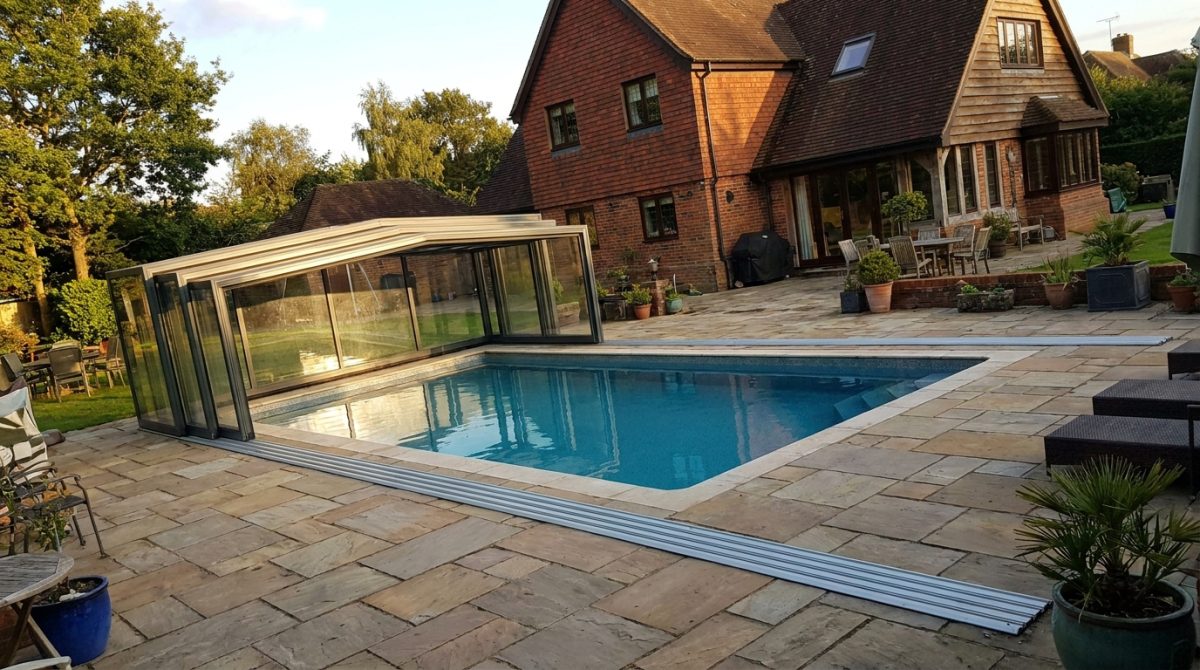
The range of enclosure formats available gives homeowners meaningful choice about how the structure integrates with the property. At one end, low-profile telescopic models retract flush with the surrounding terrace when not in use, preserving garden sightlines and remaining largely invisible from the house. At the other, high-profile structures with vertical glazed walls function as dedicated pool houses, providing standing room, storage, and a fully enclosed environment that operates independently of outdoor temperature. The choice is not purely aesthetic. Higher-profile structures may require planning permission where lower-profile retractable models typically fall within permitted development rights, so the decision has practical as well as visual implications. For homeowners thinking about the year-round swimming proposition, the enclosure and the heating system need to be considered together from the outset rather than as sequential purchases.
Which UK Properties Are the Right Candidates for Pool Investment
A pool is not a universal improvement, and pretending otherwise would be a disservice to any homeowner considering the investment. The starting point is always the plot. The shell itself requires a minimum footprint of roughly 7 metres by 3.5 metres, and that is before you account for the surrounding terrace, which needs to be wide enough to function as usable space rather than a narrow margin, the plant room, and safe access around the perimeter. On a compact suburban plot, a pool can dominate the garden to the point where it reduces rather than adds value, because buyers in that market place high importance on usable outdoor space for children or entertaining.
The price bracket of the home is the second filter. Value uplift from a pool installation is most reliably achieved in properties priced at £600,000 to £750,000 and above in their local market. Below that threshold, buyers are less likely to be drawn to pool ownership, more likely to object to the running costs (realistically £2,000 to £4,000 annually for energy, chemicals, and routine maintenance), and less able to absorb the installation spend into a sale price without the arithmetic becoming unflattering. Above that threshold, premium features are expected, buyers have typically encountered pools in peer households or holiday properties, and the running cost figure is proportionally smaller relative to total housing expenditure.
Geographically, the strongest UK markets for pool investment are well-established. Surrey, Berkshire, Buckinghamshire, Kent, and the Cheshire Golden Triangle consistently produce the buyer demographic that actively filters for pool properties rather than simply tolerating them. These are areas where aspirational family buyers, many of them relocating from London or from high-density commuter towns, are looking for a home that delivers a lifestyle step-change alongside the practical benefits of more space. A pool in these markets is a search filter, not an afterthought.
The most compelling candidates are properties that already sit at or near the ceiling of their immediate comparables but lack a feature that justifies pricing meaningfully above them. If every four-bedroom detached house on a given road has sold in a £900,000 to £950,000 range over the past three years, a vendor without a differentiator has limited room to move. A well-specified pool with enclosure provides that differentiator and gives the selling agent a concrete, photographable, marketable reason to position the property above the cluster.
The relocation buyer deserves particular attention here. Families moving out of London to a larger commuter property are statistically more likely to have encountered pool ownership through social peers, overseas travel, or previous city properties with communal pool facilities. The aspiration is already formed. A pool on the spec sheet confirms that the new home will deliver the lifestyle upgrade the move is meant to represent, and that confirmation has measurable influence on both viewing rates and offers.
Swimpools recommends a pre-investment consultation before any commitment is made. The assessment covers plot suitability, access for installation machinery, local planning requirements (the pool shell itself generally falls under permitted development, but enclosures above certain heights or footprints may require consent depending on the local authority and proximity to boundaries), and a realistic view of likely value impact given the specific property and market. The consultation costs nothing, but skipping it can cost considerably more.
Numbers Behind the Premium: What a Pool Actually Costs Versus What It Returns
Premium residential pool installations in the UK start at around £30,000 for a composite shell with standard groundworks. Once you add a quality enclosure, heat pump, LED lighting, and landscaping integration, the all-in figure typically sits between £60,000 and £80,000, and can move above that for larger plots or more architectural designs. That range sounds significant until you put it next to what a well-specified pool can do to an asking price.
UK property ROI data consistently suggests a well-installed pool on the right property can add between 5 and 15 percent to the sale price. The upper end of that range is achievable when the pool includes an enclosure and a properly finished surround, rather than a shell sitting in bare earth. On a £900,000 property, a 10 percent uplift represents £90,000 in additional value. If the all-in installation cost was £65,000, the pool has a theoretical net positive return at the point of sale, before factoring in a single day of personal use.
Running costs must be factored in honestly. With modern heat pump technology, energy costs for heating average between £800 and £1,500 per year, depending on pool volume, target temperature, and how often the enclosure is used to retain heat. Add chemicals and routine servicing, and total annual running costs typically fall in the £2,000 to £4,000 range for a well-maintained installation.
This is where composite construction makes a measurable difference over 20 years of ownership. Concrete pools require acid washing, replastering, and periodic resurfacing, each costing thousands at a time. Composite shells carry no such cycle. Their non-porous surface reduces chemical consumption, structural repairs are rare, and the premium property market increasingly treats verified low-maintenance specifications as a selling point in their own right.
There is also a return that no valuation report will ever capture properly. A family that installs a pool when their children are eight and twelve will have seven or eight years of holidays spent at home, of long summer evenings, of a garden that actually gets used. That quality-of-life return is real, compounding every season before the property ever goes to market. The financial case is strong for the right home. But the case that is hardest to argue against is the one you live rather than calculate.
Making the Pool Work as a Marketing Asset, Not Just a Feature
A pool that is not presented correctly will do almost nothing for your sale. Water that looks even slightly green, a smeared enclosure panel, or a terrace scattered with garden furniture and pool toys will undermine the entire investment at the moment it matters most. Before viewings and before the photographer arrives, the water must be chemically balanced and visually clear, the glass panels on the enclosure must be spotless, and the surrounding terrace must be clean, simply staged, and free of clutter.
Listing photography should include at least one hero shot taken with the enclosure partially open. That single image does something no description can: it shows the sheltered, climate-controlled interior and the open garden connection at the same time, making the case for year-round usability without requiring a word of explanation. A buyer seeing that photograph understands immediately that this is not a seasonal indulgence.
Sellers should prepare a one-page pool information document for viewings. It should cover the manufacturer warranty (Leisure Pools composite shells carry a transferable lifetime structural warranty, which passes to the new owner), the annual running costs in real numbers, the enclosure’s usability across all four seasons, and any service history. Agents report that informed buyers ask about warranties and maintenance contracts early in the process. Having documented, specific answers ready closes that objection before it becomes a negotiation point.
Swimpools provides post-installation support, service packages, and full technical documentation that homeowners can hand directly to their agent. Those documents turn a pool from a feature that buyers might worry about into one they feel confident inheriting, and that shift in perception is exactly where a pool earns its place on the spec sheet rather than just the floor plan.