
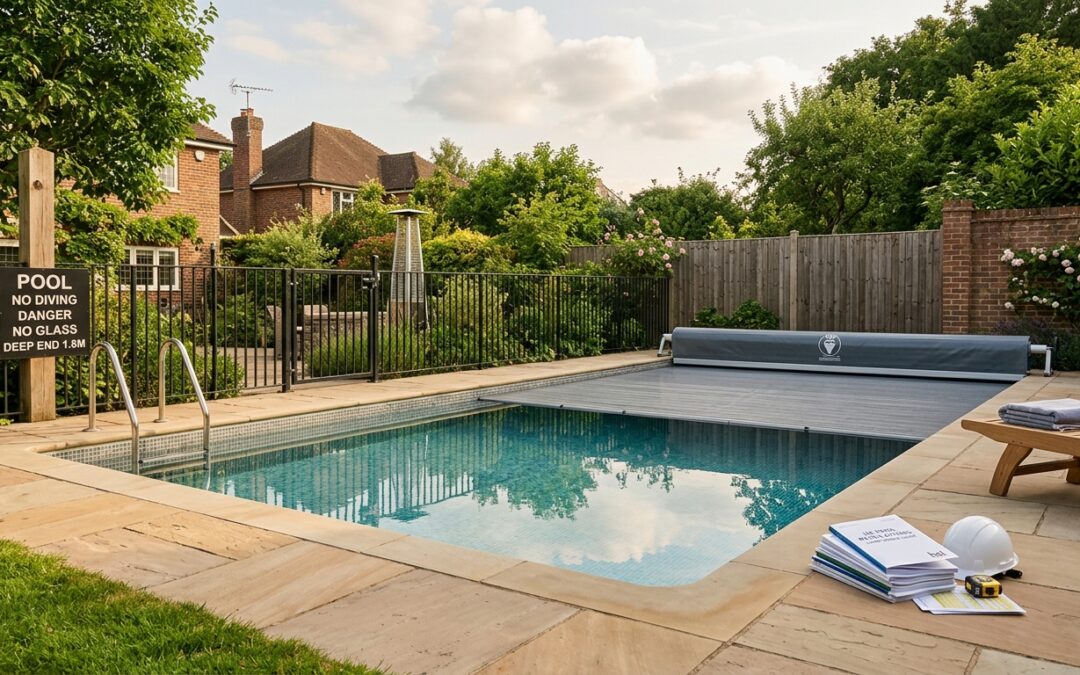
Installing a swimming pool is one of the most significant investments a homeowner can make. The excitement of picking a shell design or debating the merits of a pool enclosure is real, but before any groundwork is broken, there is a layer of regulatory groundwork that needs attention first. The rules covering private pools in the UK span planning permission, building regulations, and safety standards, and they are not entirely uniform across the four nations.
Getting this right at the outset saves you from costly retrospective applications, enforcement notices, or in the worst cases, having to remove what you have built. Here is a practical breakdown of what applies where.
Planning Permission: Do You Need It?
For most residential pools in England, a private outdoor swimming pool falls under Permitted Development rights, meaning you may not need to apply for planning permission at all. However, there are important conditions attached to that exemption.
- The pool and any associated structure must not cover more than 50% of the total garden area.
- It should not be built forward of the principal elevation of the house or beside a highway-facing elevation.
- If your property is a listed building, or sits within a Conservation Area, National Park, Area of Outstanding Natural Beauty, or World Heritage Site, Permitted Development rights are restricted or removed entirely.
In those circumstances, a full planning application is required. Your local planning authority will consider the visual impact, drainage, and any effect on neighbours. Pools with substantial structures around them, such as large plant rooms or permanent enclosures, may also trigger the need for consent even on standard residential plots.
How Scotland, Wales, and Northern Ireland Differ
Scotland operates under its own planning framework. Permitted Development rights for householders in Scotland are set out in Scottish Government guidance, and while a straightforward in-ground pool in a back garden will often fall within those rights, any associated decking over 30cm high or an enclosure large enough to be considered a building will need a planning application.
In Wales, Permitted Development rules broadly mirror those in England, but the Welsh Government has been progressively tightening householder rules over recent years. If your project sits within a designated area, you should contact your local planning authority directly rather than assume an exemption applies.
Northern Ireland has its own system administered under the Planning Act (Northern Ireland) 2011. Permitted Development rights exist for domestic swimming pools, but limits on the proportion of garden covered and restrictions near boundaries still apply. The Planning Portal for Northern Ireland is the correct starting point for checking specific requirements.
Building Regulations: The Structural and Safety Side
Planning permission and building regulations are separate processes, and a pool that does not require the former may still need to comply with the latter. In England and Wales, Building Regulations approval is typically required where the pool involves significant excavation, structural elements, or connections to drainage and electrical systems.
Key areas the regulations address include:
- Electrical installations: All electrical work associated with a pool must comply with Part P of the Building Regulations in England and Wales. Given that water and electricity present serious hazards, this is non-negotiable. Any contractor carrying out pool-related electrical work should be registered with a competent person scheme such as NICEIC or NAPIT.
- Drainage and water management: Part H covers drainage. Backwash water and pool drainage must be managed correctly, and connection to a public sewer may require permission from your water company.
- Structural integrity: If a pool is within 3 metres of a building’s foundations, or where ground conditions are complex, structural calculations will be required.
In Scotland, the equivalent framework is the Building (Scotland) Regulations 2004, administered by your local authority building standards department. Northern Ireland uses the Building Regulations (Northern Ireland) 2012. The principles are similar, but the specific technical standards and approval routes differ, so always engage a building control body familiar with the relevant national framework.
Safety Standards for Private Pools
There is no single piece of UK legislation that mandates safety barriers for private residential pools in the same way that some US states, for example, require four-sided fencing. However, that does not mean safety standards are optional or unimportant.
Under the Health and Safety at Work Act 1974 and associated regulations, if any member of staff works at your property (a cleaner, a gardener, a pool maintenance technician), you carry duties as an employer or as someone who controls premises. The pool area must be maintained in a safe condition for anyone with lawful access.
More directly relevant to most homeowners is the duty of care under the Occupiers Liability Act 1957 and 1984. If a child or uninvited visitor gains access to your pool and suffers harm, the question of what reasonable precautions you had in place will arise. Best practice guidance, including that published by the Royal Society for the Prevention of Accidents, recommends:
- A lockable, self-closing pool barrier or fence that prevents unsupervised access by children.
- Pool covers that are rated to bear weight, not simply decorative solar covers.
- Clearly visible depth markings and appropriate safety equipment (a reaching pole and a throw rope) stored nearby.
- Good lighting around the pool surround if the pool is used in the evenings.
These are not legally mandated checklist items for private homes, but they represent the standard any responsible pool owner should meet. Some home insurers are now asking specific questions about pool safety measures when setting policy terms, so there is a practical financial dimension too.
Pool Enclosures and Additional Structures
Enclosures are growing in popularity in the UK, partly because they extend the usable season significantly and partly because modern designs are genuinely attractive. A low-profile retractable enclosure sitting close to the ground will usually fall within Permitted Development in England, but a tall, permanent structure with a substantial footprint is more likely to require planning permission.
The key questions your local planning officer will consider are height, proximity to boundaries, and visual impact from public vantage points. An enclosure that is retractable, low in profile, and finished in materials sympathetic to the property will generally attract less scrutiny than a fixed greenhouse-style structure.
Working With the Right Professionals
The single most effective thing you can do before committing to a pool project is speak to your local planning authority at the pre-application stage. Most councils offer a paid pre-application advice service. It takes a few weeks and costs a modest fee, but it gives you a written steer on whether your project is likely to be approved, and on what terms.
A reputable pool installer will be familiar with the planning and building control landscape in your area and should be able to flag issues before they become problems. At Swimpools, our team works with homeowners from initial design through to installation, including guidance on the regulatory steps involved, so that the path from planning to first swim is as straightforward as possible.
The regulations are genuinely manageable when you approach them early and with the right support. Getting that groundwork right means your pool can be enjoyed with complete peace of mind for years to come.